1、 Case Study
Case Study
—
Vehicles equipped with AEB system may experience unexpected triggering of AEB function for emergency braking due to random hardware failure of AEB controller (such as memory error bit inversion), resulting in rear end collision with the preceding vehicle and causing injury or death to the driver and passengers. This type of functional failure caused by internal system or controller failures, random hardware failures, or AI failures is generally classified as a functional safety issue.

Case 2
—
As shown in the figure below, the AEB algorithm mistakenly identified the small truck pattern on the billboard as the vehicle ahead, which unexpectedly triggered the AEB function for emergency braking. The driver behind did not have time to react, resulting in a rear end collision with the vehicle in front. The result may seem similar to Case 1, but the reasons are completely different. This type of safety issue that endangers the safety of drivers and passengers due to insufficient functionality (insufficient specification definition, limited sensor performance, insufficient AI recognition), environmental impact (known or unknown scenarios), or personnel misuse (direct or indirect misuse) is generally classified as an expected functional safety issue.

Case 3
—
A group of Chinese white hat hackers claimed through a video that they had hacked into the Tesla Model S system and, for the first time, were able to control turn signals, seat positions, and door lock systems without physical contact with Tesla. What's even more terrifying is that they can control the vehicle to suddenly brake through remote control during the driving process. We can classify this type of intentional attack on vehicles through physical or remote wireless means, resulting in issues of driving safety or privacy leakage, as a cybersecurity problem.

Dialogue with Cohen Lab Hacker Leader: How We Hacked Tesla's In Car System -10% Company - The Paper
2、 Summary
Through the sharing of the above three cases, we can see that the same result (AEB emergency braking leading to a rear end collision) can be attributed to various reasons; Overall, it can be classified from internal and external factors of the vehicle, with internal factors being classified as functional failure and insufficiency, and external factors being classified as environmental impact, personnel misuse, and intentional behavior.
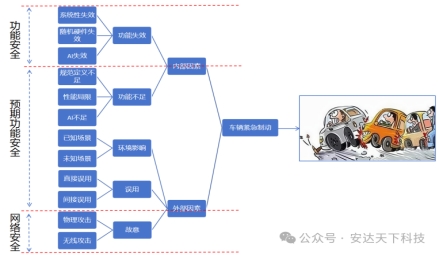
In summary, functional safety, expected functional safety, and network safety each have their own advantages in solving problems. Xiao An summarized the differences between them as shown in the above figure.